


Kudumbigala Monastery: Remote Rock Caves, Forest Silence and Panoramic Views Near Kumana
Kudumbigala Monastery is one of the most powerful spiritual landscapes on Sri Lanka's east coast. Hidden among forest, rock outcrops and dry-zone wilderness near Kumana National Park, this remote monastery offers a very different experience from the busy beaches of Arugam Bay. It is a place of caves, ancient ruins, walking paths, forest silence and wide panoramic views across the southeastern plains.
For spiritual travelers staying in Arugam Bay, Panama, Okanda or visiting Kumana, Kudumbigala is a remarkable feature. It combines Buddhist heritage with raw natural beauty. The journey itself feels like leaving the ordinary world behind. Roads become quieter, the forest thickens, the land grows wilder, and then the great rocks of Kudumbigala rise from the landscape like guardians of an old meditation world.

A Remote Monastery Close to Kumana
Kudumbigala is located in the southeastern dry zone, close to the Kumana National Park area and within travel range of Arugam Bay. Many travelers visit it as part of a wider east-coast journey, combining surf beaches, Kumana birdlife, Okanda coastal scenery and ancient Buddhist heritage. This combination makes Kudumbigala especially valuable for visitors who want something deeper than a beach holiday.
The monastery is remote, and that remoteness is part of its beauty. It is not surrounded by hotels, shops and heavy traffic. Instead, the visitor finds forest, scrubland, rock formations and a sacred atmosphere. The area can feel hot, quiet and powerful. Because it is close to wildlife habitats, visitors should move carefully, follow local guidance and avoid wandering alone into unknown forest areas.
Ancient Caves and Forest Hermitage Life
Kudumbigala is famous for its ancient caves and rock shelters. Travel and heritage references often mention more than 200 caves or rock shelters in the area, many associated with the life of forest monks. These caves were used as simple dwellings, meditation spaces and places of seclusion. They show how Buddhist monastic life in Sri Lanka was deeply connected with forest, rock and silence.
Unlike decorated city temples, Kudumbigala's beauty is austere. A cave, a stone path, a simple shrine, a weathered inscription or a quiet monk's dwelling can carry more feeling than elaborate architecture. The monastery reminds visitors that early Buddhist practice often valued solitude, simplicity and closeness to nature. Here, the forest and the rocks are part of the spiritual teaching.
The Rock Climb and Panoramic Views
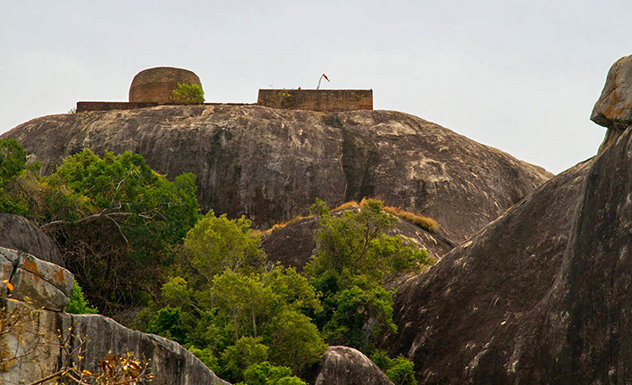
One of the strongest features of Kudumbigala is the climb to the upper rock area. The path passes through forest and rocky ground before reaching higher granite surfaces. In some places, steps and railings help visitors move upward, but the climb still requires care. The heat, rock surface and exposed sections can be challenging, especially in the middle of the day.
The reward is unforgettable. From the summit area, the view opens across forest, plains, distant lagoons, isolated rocks and the direction of Kumana and the coast. Many visitors describe the panorama as one of the finest in the Arugam Bay region. The feeling at the top is spacious and still. The landscape stretches in every direction, and the remote character of the monastery becomes clear.
A Sacred Stop for Arugam Bay Travelers
Arugam Bay is famous for surfing, beach life and a relaxed coastal mood. Kudumbigala gives that journey a spiritual balance. A traveler can spend one day by the waves and another morning among caves, forest and ancient meditation spaces. This contrast is one of the great strengths of the east coast: adventure, beach culture, wildlife and Buddhist heritage can exist close together.
For visitors staying in Arugam Bay, Kudumbigala is best approached as a respectful half-day or day excursion, often combined with Kumana, Panama or Okanda depending on time and transport. Early morning is usually better than midday because the heat can become strong. Good shoes, water, modest clothing and patience are important.
Forest, Wildlife and Silence
The forest around Kudumbigala is part of its atmosphere. Dry-zone trees, scrub, rocks and open spaces create a rugged landscape. Birds, reptiles and mammals may be present in the wider area, especially because of the connection with Kumana's wildlife region. Visitors should remember that this is not a controlled garden. It is a wild and sacred environment.
Silence is important here. Some parts of Kudumbigala are connected with monastic life and meditation. Loud voices, careless photography and casual behavior can disturb the dignity of the place. A respectful visitor moves slowly, speaks softly and remembers that the monastery is not only a scenic viewpoint. It is a place where people have sought solitude and spiritual training for generations.
History and Buddhist Heritage
Kudumbigala is often described as an ancient monastery complex with roots going back more than two thousand years. Some travel references connect it with the early Buddhist period and with ancient kings of Sri Lanka. Whether one focuses on exact dates or the wider tradition, the important point is clear: this is a historic forest monastery landscape, not a newly created attraction.
The caves, ruins and rock formations show a form of Buddhist heritage that is different from the great stupas of Anuradhapura or the painted cave temples of Dambulla. Kudumbigala's heritage is quieter and more rugged. It belongs to monks who lived in caves, meditated in forests and used the natural landscape as part of their discipline.
Practical Tips for Visiting
Visitors should prepare well before going to Kudumbigala. The area can be hot, and shade may be limited in exposed rock sections. Carry enough water, wear comfortable shoes and avoid climbing during the harshest heat of the day. A hat can help, but modest clothing is also important because this is a sacred place. Shoulders and knees should be covered when possible.
It is also wise to travel with a local guide or reliable driver who knows the route and current conditions. Mobile signal may be weak in some areas, and road conditions can change. Because the area is close to wildlife zones, visitors should not wander away from known paths. If wildlife is seen, keep distance and avoid approaching for photographs.
Respectful Spiritual Travel
Kudumbigala is ideal for spiritual travelers, photographers, history lovers and nature-minded visitors, but it asks for a respectful attitude. The goal should not be only to collect dramatic photos. The deeper experience comes from understanding the silence of the caves, the patience of the climb and the humility of standing in a place shaped by centuries of monastic practice.
Visitors should avoid leaving any litter, touching fragile ruins unnecessarily or disturbing monks and devotees. If there are signs or local instructions, they should be followed. This kind of travel protects the monastery and also makes the experience more meaningful.
A Hidden Spiritual Feature Near Kumana
Kudumbigala Monastery is one of the great hidden spiritual features for travelers visiting Arugam Bay and Kumana. It has caves, forest, rock paths, ancient history and panoramic views that open the mind to the scale of the landscape. It is remote, but that remoteness is exactly what gives it power.
For anyone seeking a deeper east-coast journey, Kudumbigala is unforgettable. It shows a side of Sri Lanka where nature and Buddhist practice meet in a raw, quiet and beautiful way. In the silence of its caves and the wind over its rocks, the monastery reminds visitors that some of the island's greatest treasures are found far from the main road.



Loading comments…