


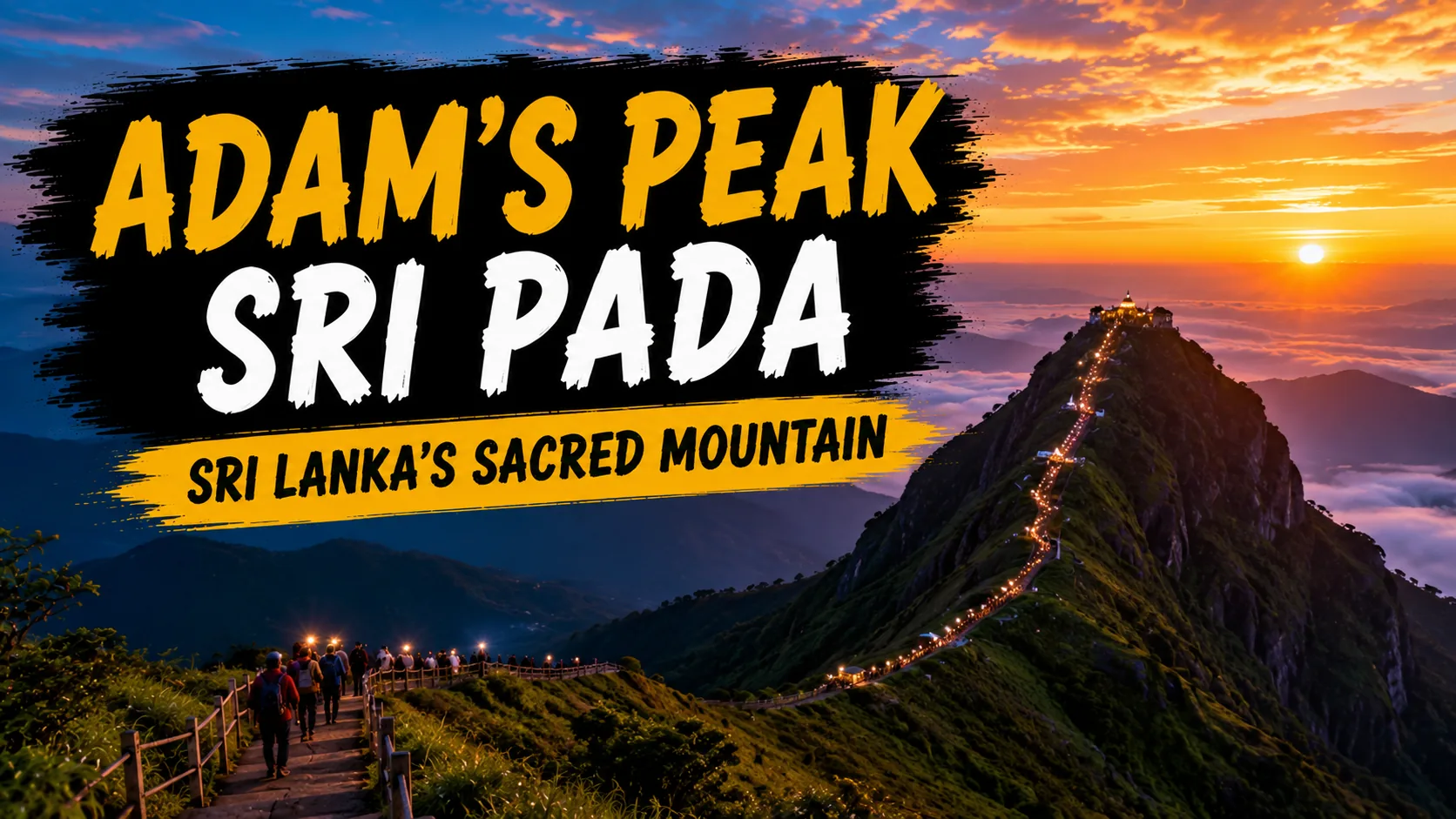
Adam's Peak / Sri Pada: Sacred Mountain, Pilgrimage Routes and the Cable Car Proposal
Adam's Peak, known in Sri Lanka as Sri Pada or Samanala Kanda, is one of the island's most sacred and unforgettable mountains. Rising to about 2,243 meters, it stands with a distinctive conical shape above the forested hills of the Central Highlands. For centuries, pilgrims have climbed this mountain not only to see a sunrise, but to worship, give thanks, make vows, and experience a journey that joins faith, endurance and nature.
Sri Pada is special because it is respected by people of several faiths. Buddhists believe the sacred footprint at the summit is the footprint of the Lord Buddha. Many Hindus connect it with Lord Shiva. Some Muslims and Christians associate it with Adam or St. Thomas. Because of these traditions, the mountain has become a rare spiritual meeting place where different communities walk the same steps with different prayers, but often with the same humility.
A Mountain of Faith
The heart of Sri Pada is the sacred footprint shrine near the summit. Pilgrims climb for hours to reach this place, where the mountain air is cold, the sky feels close, and the act of worship becomes deeply personal. Some visitors come with strong religious devotion. Others come because they have heard stories from parents and grandparents. Many travelers come for the famous sunrise, but even they often feel the spiritual weight of the journey.
The pilgrimage season usually runs from December to May. During this time, the main paths are lit at night, tea shops and rest places open, and the climb becomes part of a larger national rhythm. Families, monks, elders, young people, local villagers and foreign travelers move upward together. Some climb quickly, while others stop often, resting, chanting or sharing food. The mountain teaches patience because every pilgrim must climb step by step.
The Sunrise at the Summit
One of the most famous reasons to climb Adam's Peak is the sunrise. Pilgrims usually begin the ascent at night so they can reach the summit before dawn. When the first light appears, the surrounding hills slowly emerge from darkness. Mist moves through valleys, clouds turn gold, and the cold wind at the top becomes part of the memory.
At sunrise, the mountain can cast a remarkable triangular shadow over the landscape below. Many visitors wait quietly for this moment. It is not only a beautiful view; it feels symbolic. After a difficult night climb, the first light brings relief, gratitude and wonder. For some, it is a spiritual reward. For others, it is one of the most dramatic natural scenes in Sri Lanka.
Several Routes to Sri Pada
Adam's Peak can be reached by several routes, and each route has its own character. The most popular modern route is the Hatton-Nallathanniya route. Many pilgrims and travelers choose it because it is shorter, more developed and easier to access from Hatton by road. During the season, this route has lighting, food stalls, tea shops and resting points, making it the most practical option for many visitors.
The Ratnapura-Palabaddala route is older and more traditional. It is longer than the Hatton route and can feel more demanding, but many devotees value it for its historic pilgrimage feeling. The Kuruwita-Erathna route is also known among serious walkers and nature lovers. It is generally considered longer and less supported than the main route, but it offers a stronger forest atmosphere and a quieter experience when conditions are suitable.
Other lesser-used routes include Murraywatte, Mookuwatte and Malimboda. These paths are not commonly used by ordinary visitors and should not be attempted casually. Anyone choosing a less popular route should get local guidance, check weather conditions and understand the physical demands. Sri Pada is sacred, but it is also a real mountain landscape where mist, rain, darkness and fatigue can become serious challenges.
The Night Climb
The climb is made of thousands of steps, and even the shorter route can be tiring. Pilgrims often start late at night or very early in the morning. The air becomes colder as the path rises, and the body begins to feel the steady effort of climbing. Tea shops along the way are more than businesses; they become small islands of warmth, light and human kindness. A cup of hot tea, a simple snack or a few minutes of rest can give new strength.
Good preparation is important. Visitors should wear comfortable shoes, carry warm clothing, bring water, keep a small torch or headlamp, and avoid carrying unnecessary weight. During the pilgrimage season, the main routes are busy and safer, but crowds can also slow the climb. Outside the season, the mountain can be affected by heavy rain, strong wind, mist and fewer facilities, so casual travelers should be more careful.
Nature Around the Sacred Mountain
Sri Pada is not only a religious site. It is also part of a rich natural landscape of forested hills, mountain streams, wildlife habitats and important watersheds. The surrounding region is closely linked with rivers and rain. The mountain area contributes to the life of several river systems, and its forests help protect water, soil and biodiversity. This natural value is one reason many people are sensitive about development around Sri Pada.
As pilgrims climb, they pass through changing scenery: village edges, steps, forest shade, tea stalls, misty slopes and open views. In the darkness, the mountain is felt through sound and movement. In daylight, the greenery and distant hills reveal another kind of beauty. For photographers and nature lovers, the descent can be just as rewarding as the climb because the path shows details that were hidden at night.
The Cable Car Proposal
In 2026, reports said the Sri Lankan government was considering cable car facilities at Sri Pada and several other tourist destinations as part of tourism infrastructure discussions. However, this should be understood carefully. Based on available reports, the Sri Pada cable car is a proposal or discussion, not a newly built and operating system. Reports also stated that environmental clearance had not been granted for such a project at the time.
The cable car idea is sensitive because Sri Pada is not an ordinary tourist attraction. It is a sacred pilgrimage mountain, an environmental area and a cultural symbol. Supporters may see easier access as helpful for tourism and for people who cannot climb thousands of steps. Critics worry about environmental damage, commercialization and changes to the spiritual nature of the pilgrimage. Any future decision would need deep respect for religion, ecology, local communities and the long tradition of walking to the summit.
Respectful Travel
Visitors to Adam's Peak should remember that they are entering a sacred place. Clothing should be modest, behavior should be respectful, and photography should be done with sensitivity around worshippers. Littering is especially harmful on the mountain, so travelers should carry back their waste and avoid plastic where possible. The steps, tea shops and rest areas serve thousands of people during the season, and every visitor has a role in keeping the path clean.
It is also important to respect the pace of pilgrims. Not everyone on the mountain is there for tourism. Some are fulfilling vows, carrying family prayers or making a once-in-a-lifetime religious journey. A kind word, patience in crowded sections and quiet behavior near the summit help preserve the dignity of the place.
A Journey That Stays in the Heart
Adam's Peak is difficult, beautiful and deeply meaningful. The steps test the body, the cold air wakes the mind, and the sunrise gives the journey a golden ending. But the real value of Sri Pada is not only at the top. It is in the shared climb, the lamps along the path, the sound of prayers, the kindness of strangers and the feeling that many faiths can meet on one sacred mountain.
For travelers, Sri Pada offers one of Sri Lanka's most powerful experiences. For pilgrims, it remains a holy journey of devotion. For the island, it is a symbol of faith, nature and unity. Whether the future brings new facilities or not, the heart of Adam's Peak should always remain the same: a sacred mountain climbed with respect, patience and gratitude.



Loading comments…