


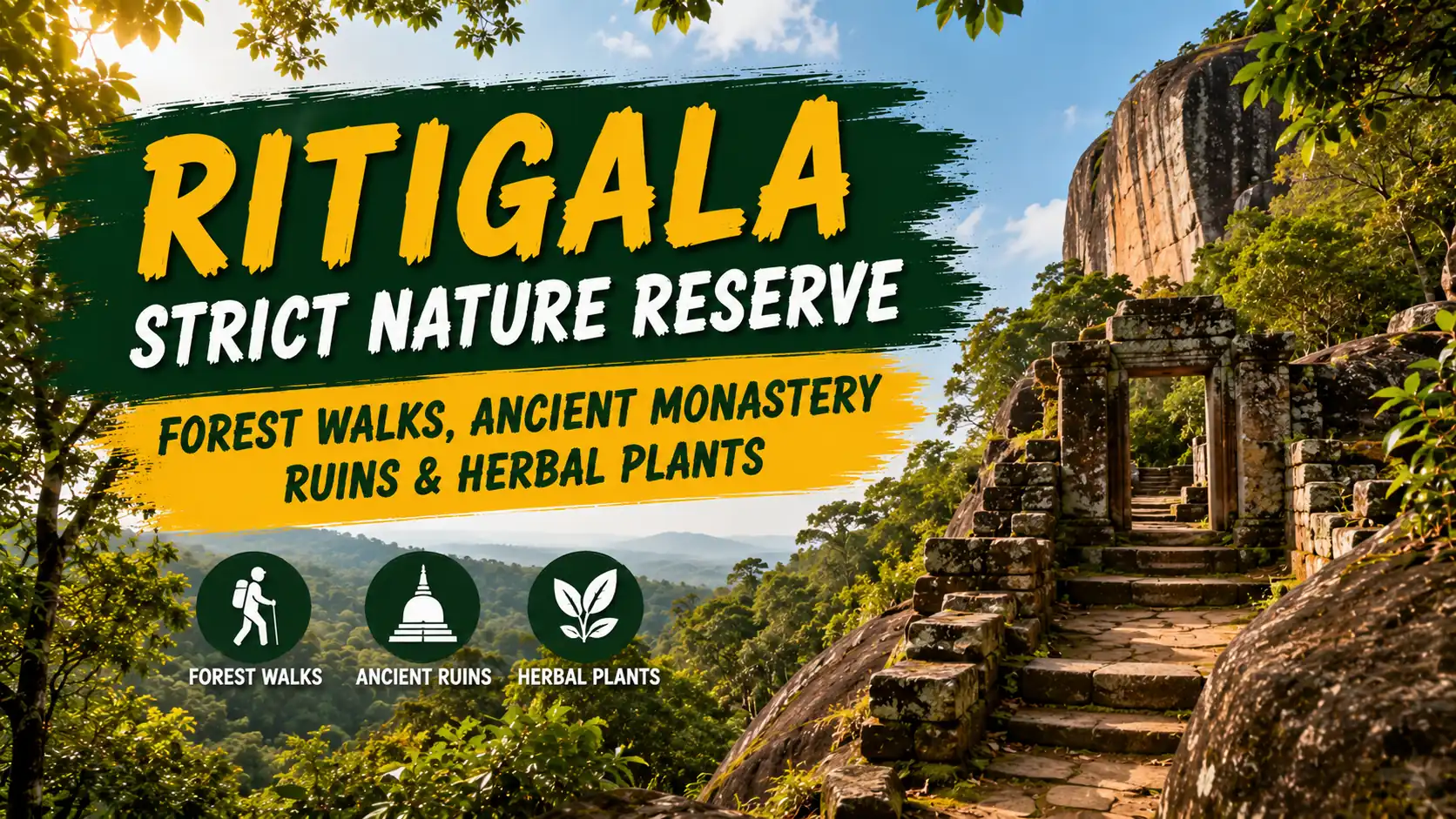
Ritigala Strict Nature Reserve: Forest Walks, Ancient Monastery Ruins, Herbal Plants and Natural Calm Climate
Ritigala Strict Nature Reserve is one of the most mysterious and peaceful places in Sri Lanka's Cultural Triangle. Rising from the dry plains near Anuradhapura, Kekirawa, Habarana and Dambulla, Ritigala is a forested mountain where nature, archaeology, legend and meditation history meet. It is known for ancient Buddhist monastery ruins, shaded forest walks, a cooler mountain microclimate, rare plant communities and stories about powerful medicinal herbs.
Unlike many famous tourist sites, Ritigala does not impress visitors with large stupas, polished statues or bright temple buildings. Its beauty is quieter. A stone path disappears into the forest. Old platforms sit under trees. Roots cover ancient masonry. Birds call from the canopy. The air becomes cooler than the dry plains below. The whole place feels like a hidden monastery slowly returning to the jungle.
A Mountain Rising from the Dry Zone
Ritigala is a mountain range in Sri Lanka's North Central region, not far from the ancient city of Anuradhapura. The mountain rises sharply from the surrounding plain, making it one of the most striking natural features in the dry-zone landscape. Its highest peak, Ritigala Kanda, reaches about 766 meters above sea level and stands much higher than the surrounding lowlands.
This sudden height creates a special climate. While the plains around Ritigala can be hot and dry, the upper slopes are cooler, wetter and often misty. Moisture-bearing winds meet the mountain and create rainfall and condensation. Because of this, Ritigala has a natural calm climate that feels surprisingly fresh compared with the heat below. Visitors walking into the forest often notice the change: shade deepens, the air softens, and the sound of the road fades behind them.
This climate is part of Ritigala's magic. It supports a forest environment that feels different from the surrounding dry country. The mountain becomes an island of greenery, a place where history and ecology are protected together.
Ritigala Strict Nature Reserve
Ritigala was declared a strict nature reserve in 1941. It covers about 1,528 hectares, and visitation and use are carefully controlled because of its conservation value. A strict nature reserve is not an ordinary picnic forest. It is protected for biodiversity, ecological balance and scientific importance. Travelers should therefore treat Ritigala with special respect.
The reserve contains dry mixed evergreen forest, disturbed forest, short-stature forest on humid ridge areas, rock outcrop plant communities and scrub. This variety is one reason Ritigala is important. The mountain creates different habitats within a relatively compact area. Trees can form a closed canopy, while rocky areas and ridge tops support smaller, tougher vegetation adapted to wind, humidity and exposed stone.
For visitors, this means the forest walk is not only scenic. It is a walk through a protected ecological system. Every plant, root, fallen leaf and shaded stream belongs to the reserve. Nothing should be collected. No herbs, flowers, stones or pieces of ruins should be removed. The best way to experience Ritigala is to walk quietly and leave it untouched.
Forest Walks and Natural Silence
The forest walk at Ritigala is one of the most memorable parts of the visit. The path begins near the archaeological entrance and gradually leads into the ruins. Instead of a wide paved tourist road, the experience feels more intimate. Trees rise on both sides, roots cross the ground, stones appear through leaves, and the route follows the old monastic landscape.
Walking here is different from climbing a viewpoint. The purpose is not to rush to the top. In fact, much of the protected mountain is not open for casual exploration. The permitted visitor experience is centered on the monastery ruins and forest paths. That is enough. Ritigala's beauty is in slow walking, listening and noticing.
The forest creates a natural silence. Even when other visitors are nearby, sound is softened by leaves and distance. Bird calls, insects, wind and footsteps become part of the atmosphere. This calm makes it easy to imagine why ascetic monks once chose this place for meditation and simple monastic life.
Ancient Monastery Ruins
Ritigala is famous for the ruins of an ancient Buddhist monastery. The monastery remains are located on the eastern side of the mountain, near the gorge that separates parts of the range. The ruins and inscriptions are connected with early Buddhist history, with some traditions and sources linking the wider site to the 1st century BCE, while the surviving monastic complex is often associated with later forest-monk traditions.

One of the most impressive features is the stone path that winds through the forest. The path is laid with carefully shaped stone slabs, and in places it feels as if the ancient builders designed movement itself as part of meditation. There are stone bridges, raised platforms, courtyards, circular resting places and remains of buildings once used by monks.
Many of the structures are associated with Padhanaghara, or double-platform monastic buildings, known from forest monastery traditions in Sri Lanka. These were not built for luxury. They were places of discipline, seclusion, teaching and meditation. Ritigala's ruins show a different side of Buddhist architecture: austere, quiet and deeply connected with forest life.
Banda Pokuna and the Monastic Approach
Near the entrance to the monastery precinct is Banda Pokuna, an ancient man-made reservoir. It is often described as part of the approach to the monastery, possibly linked with ritual bathing or preparation before entering the monastic area. The reservoir and pathway create a sense of transition: from ordinary world to forest monastery, from heat to shade, from movement to stillness.
The engineering of the reservoir and stone pathways shows the skill of ancient builders. They worked with the mountain rather than against it. The ruins are not arranged like a city grid. They follow the land, streambeds, rocks and forest. This gives Ritigala a natural harmony that many visitors feel immediately.
Herbal Plants and Legends
Ritigala is also famous for legends about medicinal herbs. Local tradition connects the mountain with rare and powerful plants, and some stories link Ritigala with the Ramayana tale of Hanuman carrying a mountain of healing herbs. According to popular belief, a piece of that medicinal mountain fell at Ritigala, explaining why unusual herbs are associated with the area.
These stories should be understood respectfully as legend and cultural memory, not as permission to collect plants or make medical claims. Ritigala's real botanical importance is already strong because the mountain supports distinctive vegetation within a protected reserve. The idea of herbal power adds mystery, but the correct behavior is protection, not extraction.
Visitors should never pick leaves, roots, flowers, bark or seeds from Ritigala. A plant may be rare, ecologically important or protected. Even common-looking plants may belong to a delicate system. The herbal heritage of Ritigala is best honored by leaving the forest whole.
Natural Calm Climate
The phrase "natural calm climate" suits Ritigala well. The mountain creates a cooler, more humid microclimate, while the forest creates emotional calm. The air feels different under the canopy. Heat is softened by shade. Moisture lingers on leaves. Mist and cloud can gather around upper areas. Even in the dry zone, Ritigala can feel like a secret pocket of freshness.
This climate also shapes the visitor experience. A walk at Ritigala is usually more pleasant in the morning, before the day becomes too hot. After rain, the forest may feel especially alive, but paths can be slippery. Good shoes, water, modest clothing and patience are useful. This is not a place for loud rushing. It is a place for slow steps.
Respecting a Protected Sacred Landscape
Ritigala is both a protected natural reserve and an ancient monastic landscape. That combination requires care. Visitors should stay on permitted paths, follow local instructions, avoid loud music, keep food waste away from animals, and never damage ruins. Climbing on old walls or moving stones may seem harmless, but it can harm fragile archaeological remains.
Because Ritigala is quieter than many famous sites, some travelers may feel they can wander freely. That is not correct. The reserve's strict protection exists for a reason. The best visitor is one who moves lightly: looking, learning, photographing respectfully and leaving no trace.
Why Ritigala Feels Different
Ritigala feels different because it is not a single attraction. It is a meeting of several worlds. It is a mountain in the dry zone, a strict nature reserve, an ancient Buddhist monastery, a forest walk, a place of herbal legends and a cool green refuge from the plains. Its ruins are not isolated from nature; they are held inside it.
For travelers exploring Anuradhapura, Dambulla, Sigiriya or Habarana, Ritigala offers a quieter and more contemplative experience. It is less about spectacle and more about atmosphere. The old stones, shaded path, medicinal plant legends and calm climate invite visitors to slow down.
If you visit with respect, Ritigala can become one of the most memorable places in Sri Lanka's Cultural Triangle. It is a place where the forest speaks softly, ancient monks seem close, and the mountain keeps its mystery under a green canopy.



Loading comments…