


The Fishing Industry in Sri Lanka's Southern Province: Madal Net Casting, Unity, Fish Collection and Coastal Beauty
Last reviewed: June 15, 2026
The fishing industry in Sri Lanka's Southern Province is not only an occupation. It is a living culture shaped by sea, sand, teamwork, patience and inherited knowledge. Along the southern coast, from villages near Galle, Matara and Hambantota to smaller beach communities, fishing families still carry memories of traditional methods that connect people to the ocean. One of the most beautiful and community-centered methods is madal or madel fishing, also known as beach-seine fishing.
In Sinhala usage, madal is often understood as a large shore net. Older fisheries references connect the term madela with maha dela, meaning a huge net. That meaning matches the sight perfectly: a long net stretched from the sea toward the beach, ropes running across the sand, and many people pulling together until the catch slowly comes ashore.
For a visitor, madal fishing can look simple at first: a net goes out, people pull, fish come in. But anyone who watches carefully will see that it is a skilled, coordinated and social activity. It needs timing, knowledge of currents, reading of waves, strong hands, patience, leadership and unity. The beauty of madal fishing is not only in the fish caught. It is in the way a whole group moves as one.
The Southern Coast and the Life of Fishing Villages
The Southern Province has a long relationship with the sea. Coastal villages depend on fishing boats, beach landing sites, small fish markets, ice boxes, buyers, transport workers, net repairers, boat builders and families who help prepare, clean, sell, dry or cook the catch. Early morning is often the most active time. Before the full heat of the day, the beach can already be alive with fishermen, traders, baskets, ropes, gulls, crows, stray dogs, bicycles, three-wheelers and the smell of salt air.
In many places, the ocean is both beautiful and demanding. A calm blue morning may turn rough by afternoon. A good catch may come one day and disappointment the next. This uncertainty teaches coastal people to work together. No single person can control the sea. But a community can share labor, share skill, share risk and share the result.
Madal fishing shows this coastal cooperation clearly. It is a beach activity, but it begins with knowledge of the sea. Experienced fishers read waves, birds, water color and movement. They watch for signs of small fish shoals close to shore. They know which season is suitable, which wind is safe, and which stretch of beach can handle the net. In traditional settings, such knowledge passes from older fishers to younger people through practice rather than classroom lessons.
How a Madal Net Is Cast
For safety and legal reasons, madal fishing should be done only by local fishing teams who know the area, have the correct permission and understand sea conditions. The explanation below is a cultural guide for understanding the method, not an instruction for unlicensed fishing.
In a traditional madal operation, the net is not thrown by one person like a small hand cast net. It is a large beach seine that is set from a boat or by a coordinated team near the surf. One end of the rope remains on the beach. The boat carries the net out into the sea in a wide curve, often forming a half-circle or arc around a suspected school of fish. As the boat returns toward the beach, the second rope comes ashore, leaving the net spread in the water like a large wall.
The shape matters. If the net is set too narrow, fish may escape around the sides. If it is set too wide or too deep for the conditions, the pull becomes too heavy and difficult. The team must understand the current, wave direction, depth and fish movement. The person guiding the operation may watch from the boat, from the beach or from a higher place, using experience to decide when and where the net should close.
Birds can also help fishers read the sea. When terns or other seabirds gather and dive, they may indicate small fish near the surface. Fishermen combine these signs with local knowledge. This is one reason madal fishing feels like a conversation between people, sea and sky.
Cooperation, Unity and Pulling the Fish Net
The most emotional part of madal fishing is the pulling of the net. Once both ropes are on shore, teams stand on either side and begin to pull steadily. This is where unity becomes visible. The net may be heavy with water, sand, seaweed and fish. If one side pulls too fast or the other side loses rhythm, the net can twist or open. Everyone must work together.
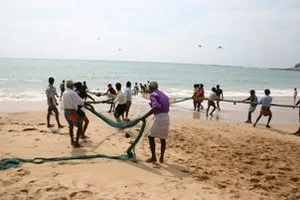
In some traditional beach-seine operations, many people may be needed to bring the net ashore. Fisheries reports on Sri Lankan madel fishing describe it as seasonal and labor-heavy, sometimes requiring dozens of people for one haul. This is why madal fishing is often remembered as a symbol of community. The work cannot succeed through individual strength alone. It needs shared timing, shared breath and shared trust.
The rhythm is almost musical. Pull, step back, gather rope, pull again. The hands become rough, feet press into wet sand, and voices rise over the surf. Older men may guide the younger ones. Some people pull, some watch the line, some keep children back, some prepare baskets, and some wait to sort the catch. On the beach, the whole operation becomes a scene of cooperation.
This unity is one of the most beautiful parts of the Southern Province fishing industry. It shows how coastal livelihoods depend not only on boats and nets, but also on relationships. A good fishing village is a network of people: net owner, boat crew, pullers, sorters, buyers, transporters, families and neighbors.
The Moment the Fish Come Ashore
As the net comes closer to the beach, excitement grows. People begin to look carefully into the water. Small flashes may appear inside the net. Children may move closer until adults call them back. Buyers become alert. Fishermen adjust their pulling so the net mouth does not open at the wrong moment.
Finally, the fish gather in the pocket of the net near the shore. This is the moment everyone has worked for. The catch may be large, small or disappointing. The sea gives according to season, weather, fish movement and luck. When the catch is good, the beach becomes busy quickly. Fish are lifted out, placed in baskets, sorted by type and size, washed if needed, weighed or counted, and prepared for sale.
Some fish go directly to local buyers. Some may be taken to the market. Some may be sold fresh to hotels, restaurants or households. Some small fish may be dried, salted or used for local cooking. In fishing villages, nothing is only one action. Pulling the net leads to sorting, sorting leads to selling, selling leads to income, and income supports families, school expenses, boat repairs, fuel, food and daily life.
Different Types of Fish Caught
Madal catches vary by beach, season, net mesh, water conditions and the movement of fish shoals. Because beach-seine fishing works close to shore, it often catches small schooling fish and mixed shore fish rather than only one species. Common examples may include salaya or sardine-like fish, hurulla or herring-type fish, anchovies, small mackerel, sprats, silver-bellies, small trevally, paraw varieties and other nearshore fish. At times, depending on the place and season, larger fish may also appear in the catch.
Official and academic sources often describe beach seines as multi-species gear. That means the catch is not always predictable. One morning the net may bring glittering small fish in large numbers. Another day it may include mixed fish, crabs, seaweed and little profit. This uncertainty is part of fishing life. It is also why fishers respect experience. Knowing when to cast the net can be as important as pulling it strongly.
Visitors should avoid judging the catch only by size. Small fish such as salaya, hurulla and anchovies are important in Sri Lankan food culture. They can be fried, curried, dried, cooked with chili and onion, or sold quickly to households. They support both nutrition and local economies.
Collecting, Sorting and Sharing the Catch
After the net is pulled ashore, the work continues. Fish must be collected before heat reduces freshness. The team may separate fish by type, remove unwanted material, clean the net and prepare for sale. Baskets, plastic crates, sacks, weighing scales and ice may appear on the beach. Buyers bargain, families help, and small traders move quickly because fresh fish has a short time window.
In traditional systems, the catch may be shared according to local custom. The net owner, boat crew, pullers and helpers may receive portions or payments depending on the arrangement. These systems can differ from village to village. What matters is that madal fishing is not simply a person catching fish alone. It is a cooperative economy on the sand.
There is also a social beauty in the way people gather around the catch. Some come to buy fresh fish for home. Some come to watch. Some help carry baskets. Some repair the net for the next day. Work, conversation and trade happen together. The beach becomes both workplace and community space.
Beauty of the Environment
The environment of madal fishing is visually powerful. The southern sea changes color from grey-blue morning to bright turquoise and deep afternoon blue. Coconut trees lean near the shore. Fishing boats rest on sand. Birds follow the waterline. The net ropes draw long lines across the beach. Fishermen move like silhouettes against the sea.
There is beauty in the physical effort too. Hands holding rope, feet pressing into sand, bodies leaning back together, voices calling across the beach: all of it shows the connection between people and place. This is not a staged performance. It is real work. That is why it feels alive.
The best time to observe such activity is usually early morning, though timing depends on local fishing practice, season and sea conditions. Visitors should keep a respectful distance, avoid standing on ropes, never block the pullers, and ask before taking close photographs of people. Buying fish directly from local sellers can be a good way to support the community, but always follow local advice and fair behavior.
Challenges and Respect for the Future
Like many traditional livelihoods, madal fishing faces challenges. Weather patterns, fuel costs, market prices, coastal development, tourism pressure, regulations, mechanized methods and environmental concerns can all affect fishing communities. Some recent public discussions in Sri Lanka have focused on mechanized pulling, beach-seine rules and the balance between livelihood and marine protection.
This is why the tradition should be respected carefully. Madal fishing is beautiful, but it is also work that supports families. It should not be romanticized in a way that ignores hardship. Fishermen face risk every day. Their income depends on the sea, and the sea is never fully predictable.
Good tourism can help if it is humble. Visitors can observe quietly, support local fishers, eat local seafood responsibly, avoid littering beaches, and learn the names of the people and fish rather than treating the beach only as a photo background. Respect keeps the culture alive.
Final Thoughts
The fishing industry in Sri Lanka's Southern Province is full of beauty because it brings together nature, labor and community. Madal fishing shows this clearly. A large net is cast with skill, pulled with unity, filled by the sea, and brought ashore by many hands. The catch may include salaya, hurulla, anchovies, mackerel, small trevally and other shore fish, but the deeper catch is cooperation.
When fishermen pull a madal net together, they show an old truth of coastal life: the sea is powerful, but people become stronger when they work as one. That unity, against the sound of waves and the light of the southern shore, is one of the quiet beauties of Sri Lanka.



Loading comments…